
What is schema markup?

Schema markup, also called structured data, is a small block of hidden code on your page that tells search engines what things on it actually are. It says "this is a business," "this is a review," "this is our phone number," instead of leaving a machine to guess. That's how you become eligible for rich results in Google, and how AI tools can quote your details without getting them wrong.
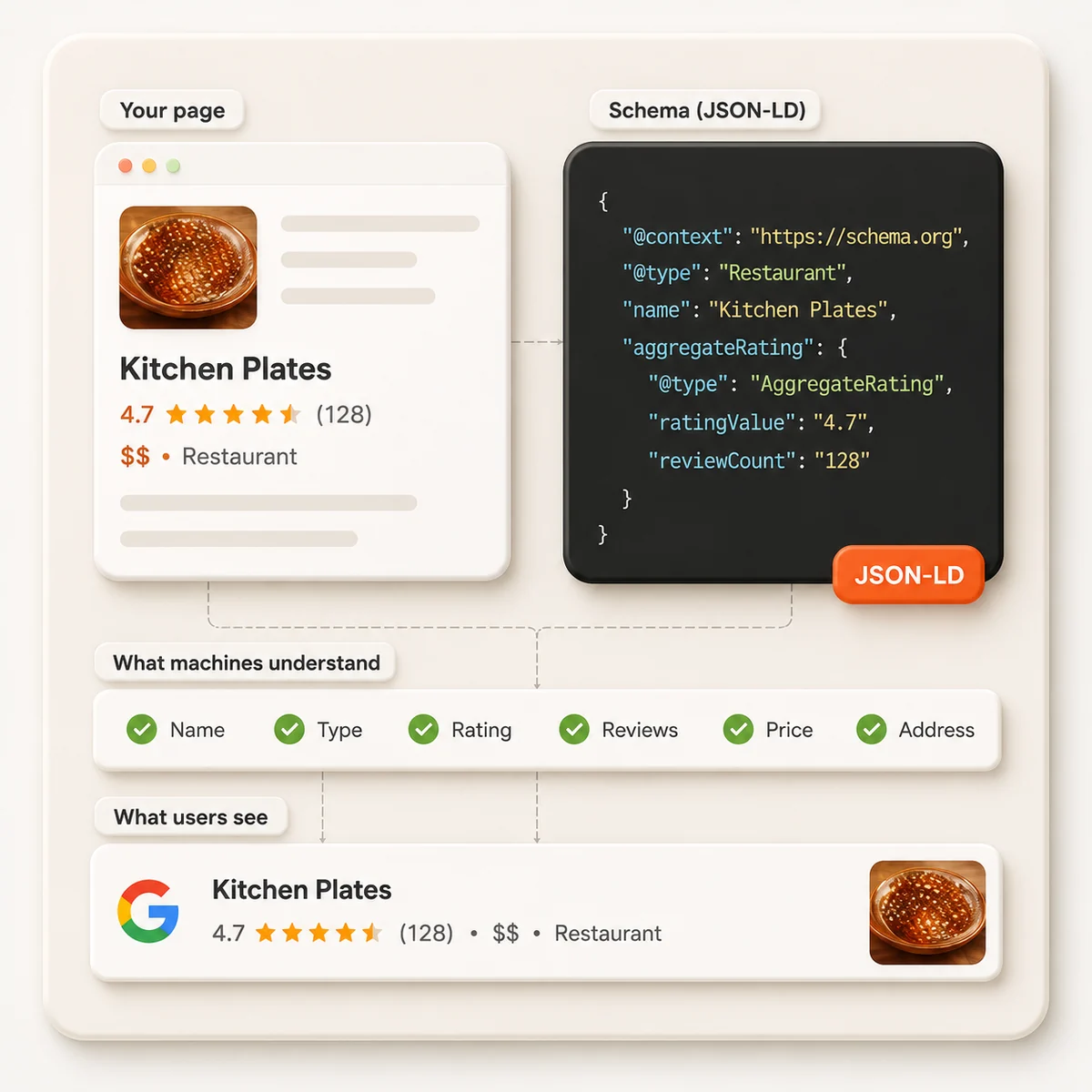
In plain English
Think of it like labelling the boxes when you move house. Anyone can open every box and guess what's inside, but if the box says "kitchen — plates," it gets to the right room instantly. Schema markup labels your page for machines: your hours, your address, your services, your reviews.
Three things to know
Visitors never see it
It lives in the code behind your page, so adding it changes nothing about how your site looks or reads.
It makes you eligible, not guaranteed
Correct markup lets Google consider you for rich results like star ratings or business info, but Google still decides what to show.
It has to match the page
The markup must describe what a visitor actually sees, so never label reviews or prices that aren't really there.
Worth remembering
JSON-LD — the structured data format Google recommends — is now used on 43% of home pages on both desktop and mobile, up from 41% on desktop and 40% on mobile in 2024. Structured data of some kind appears on 50% of home pages on both desktop and mobile.
Structured data has gone from a niche technical extra to something half the web already has: the 2025 HTTP Archive crawl found some form of structured data on 50% of home pages, with JSON-LD the dominant format at 43%. If your site is in the other half, you're handing search engines and AI tools a harder job than your competitors are. (Note the figures cover home pages; inner pages run a few points lower, at 37% JSON-LD on mobile.)
What to do about it
If you're not sure whether your site has any structured data at all, I can check it and tell you in plain English what's missing. Get a free website audit
Where this shows up in my work
 Cookies on this site